Habits of Whiteness in Medieval Fantasy
In
JRR Tolkien’s The Silmarilion, there are various tales of medieval fantasy. One is the story of Ëol and Aredhel. In this chapter, there is a tale of Ëol, a dark elf, that abducts a
light elf by the name of Aredhel. To be slightly more specific, Aredhel is on
a journey to a city far away from her home of Noldor and is separated from her guards
and then “taken” as Ëol’s wife. Based upon the context clues, Ëol rapes Aredhel
and holds her prisoner for many years. What does this tale have to do with race?
This tale of Aredhel and Ëol is rooted in the Helen Young’s idea “habits of
Whiteness” that is discussed about in her book.
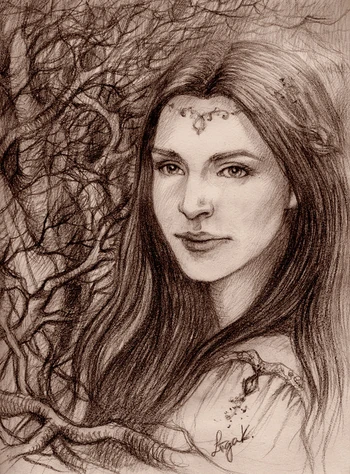 To begin, Aredhel is described as
“the White Lady of Noldor” (131). Noldor is a city near the capital composed of
the whitest elves called the Calaquendi or the “elves of light” and sometimes even
the “fair elves.” Fair is often defined as ‘light’ or ‘blond’ and ‘white.’ This
comparison already sets up the basis that whiteness is beauty and anyone not
white is considered ugly. To have Aredhel described as the “White Lady of
Noldor” means she is an even whiter version of the Calaquendi and therefore very
beautiful.
To begin, Aredhel is described as
“the White Lady of Noldor” (131). Noldor is a city near the capital composed of
the whitest elves called the Calaquendi or the “elves of light” and sometimes even
the “fair elves.” Fair is often defined as ‘light’ or ‘blond’ and ‘white.’ This
comparison already sets up the basis that whiteness is beauty and anyone not
white is considered ugly. To have Aredhel described as the “White Lady of
Noldor” means she is an even whiter version of the Calaquendi and therefore very
beautiful.
Ëol, on the other hand, is described as the “Dark Elf” that “lived
in a deep shadow” and “shunned the Noldor” (132). This just sets up the
juxtaposition of the two characters in the tale: Aredhel, the fair elf, and Ëol,
the dark elf.
Ëol upon first seeing Aredhel liked
her because “she seemed very fair to him and he desired her” which sets up the
reader to think sketchily of Ëol due to him observing her in the shadows (133).
Next, it says that “he set his enchantments about her so that she could not
find her ways out” and “drew her” to “his dwelling” (133). Finally, when she
was lead to his house, she remained because “Ëol took her to wife” which does
not set up the reader to believe that she chose to stay there. Tolkien has set
up Ëol to sound like he has rape tendencies and has a stalker mentality
juxtaposed with Aredhel who is just a damsel walking into a trap.
This set up is already morally
incorrect with today’s standards; however, given the time this was written we
have to consider societies standpoints at the time. Race was a big factor. Young’s
idea behind habits of Whiteness is that “the spaces of genre-culture have
acquired the shape of the White bodies that have habitually occupied them for
decades” (11). The idea behind these cultural associations is that they seem
unbreakable. Whiteness seems unbreakable and yet still does in today’s society.
The inspiration behind this is due to popular culture. In the early twentieth
century, the white race was considered the “elite” race and the races of color
were considered insubordinate and unimportant. I am not saying Tolkien believes
this idea; however, he was indeed influenced by popular culture. The fact he
used a “dark elf” to take advantage of and hold prisoner of a very fair “white
elf” was no coincidence. In the early twentieth century, men of color were often
killed for talking, having a relationship with, or taking advantage of white
women. Tolkien plays on this common trend and uses it in his tale.
Popular culture is a huge factor in
literary works regardless of the authors personal beliefs because he or she is
influenced by them. Tolkien uses a dark elf such as Ëol as the antagonist in
this tale to agree with popular culture.


I'm interested to see how you or other students in the class might connect this medieval fantasy rape narrative of white fear of miscegenation to twentieth century narratives or even historical examples, perhaps via Young.
ReplyDelete